Bertazzoni Cooktop E01 Error Code
A zone that answers your touch with E01 and no heat is a start-up problem; here is what gets checked and what you can look at yourself.
In-home Bertazzoni repair across the San Francisco Bay AreaMon–Sat 8 AM – 7 PM
The PE365INDXV is a 36-inch glass induction cooktop with five zones. The first service question is simple: which zones still work, and do they behave the same with a pan that works elsewhere?
Model reference

Induction cooktops can look alike while using different power modules, zone layouts and interfaces. Check the rating label or your installation papers to be sure you own a PE365INDXV. A neighboring 30-inch induction model is not a stand-in, because its zones and electronics differ.
Across its 36-inch glass top you will find five zones. Controls are touch sliders, and the feature list covers booster, bridge, a timer and a residual-heat indicator. It runs from a dedicated 208/240 V supply.
A fault can hit one zone, a bridged pair, the touch interface or the whole surface, so mapping the pattern is half the diagnosis. The bridge function links two zones to act as one larger zone, so a fault that appears only in bridge mode points toward the pairing rather than one coil.
Because the cooktop sits flush in a counter cutout, we also look at what surrounds it, such as cabinet ventilation underneath and whether a drawer or pan rack has been added below since it was installed.
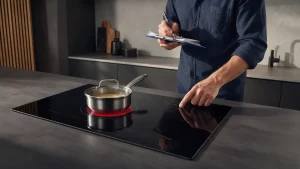
Move a pan you know works on another zone onto the problem zone, centered on the marked circle. If the trouble follows the pan, the cookware is the cause. If it stays with the zone, note whether it shows a pan symbol, heats and then stops, or only runs at low power. Induction depends on sensors, coils, power electronics and wiring working together, not on a glass “burner” that can fail alone. Pan detection is the step where a zone senses a suitable pan before the coil powers up, so a zone that shows a pan symbol with a good pan is telling us something specific.
Write down exactly which circles are affected and whether bridge mode changes anything. Paired failures often share electronics, so a clear description such as “both left zones, controls still respond” is worth more than “half is dead.”
Spills, residue or a pot lid resting on the slider can confuse the glass controls. Wipe and dry the surface, clear the area, and try again. Touch sliders respond to contact on the glass, so moisture or a metal object near the slider can register as a touch. If the panel flickers or beeps on its own, take a photo of any symbol and leave the cooktop off.
Stop cooking on cracked glass. The surface protects the electronics beneath it, and liquids reaching a crack create a hazard. A cooktop that is dead, loses power under load or trips its breaker needs electrical diagnosis; never raise the breaker size.
If it shuts down after long high-power cooking, tell us how long it ran and which zones were on, and keep cabinet airflow clear.
It has five zones under a 36-inch glass surface, with booster operation and a bridge function that can pair zones for larger cookware.
Check first that the pan is magnetic, flat and centered, and that it works on another zone. If several good pans fail on the same zone, it needs model-specific testing.
No. Stop using it, keep liquids away from the damage and arrange an inspection, because the glass covers high-voltage electronics.
Leave it off and do not enlarge the breaker. The cooktop uses a dedicated 208/240 V circuit and needs supply, wiring and zone testing.
Model-information disclaimer. Confirm your exact model number and specifications with your appliance documentation before booking a repair. Model pages are for identification and compatibility reference.
A zone that answers your touch with E01 and no heat is a start-up problem; here is what gets checked and what you can look at yourself.
E02 that arrives a minute or two into boost with a heavy pan points to a load question; this page covers what gets checked and what is safe to try.
E03 that shuts the whole cooktop down during a busy dinner and clears after a rest tells us a lot about the cause; read what to note and check.
Seeing E04 with a freshly bought pan but not with the old one points to cookware detection; here are the quick checks and when to book.
E05 that follows a spill or a wet wipe near the touch panel is a timing clue; read which checks are safe and when the panel needs a technician.
E06 that appears on the first use after a power cut or breaker flip often follows a supply event; read what to note and what is safe to check.
Whether one zone misbehaves or the whole surface is dead decides almost everything about a cooktop repair, so we begin right there.
How to describe a warm compartment, missing ice or odd fan sounds on the REF36FDFZXNT, and which checks you can safely make…
What to note when a DW24XV leaves water in the tub, cleans poorly, dries badly or leaks, and which checks are safe…
How to describe heating, uneven baking, convection fan and self-clean problems on the MAST30FSEXV, and which checks are safe at home.
Share a few details and we’ll confirm an appointment. Prefer to talk? Call us and we’ll help right away.