Bertazzoni E01 Error Code
E01 often gets noticed on the first runs after an install or remodel; its meaning depends on the control generation, so the cycle stage matters.
In-home Bertazzoni repair across the San Francisco Bay AreaMon–Sat 8 AM – 7 PM
The DW24XV is a 24-inch integrated dishwasher with a stainless tub and concealed touch controls. Tell us at which stage of the cycle it goes wrong, and diagnosis starts from there.
Model reference

The DW24XV model number is printed on the dishwasher’s rating label, and that number, not the handle, tells us which machine we are dealing with. Handle kits come in Professional, Master and Heritage styles, which means two kitchens with different-looking fronts can share one dishwasher underneath. With concealed touch controls there is no visible keypad to identify the unit, so the label is the dependable reference.
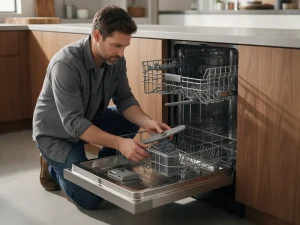
If the label is visible without pulling anything out, photograph it. A built-in dishwasher should stay in its cabinet opening unless a technician asks otherwise, especially under stone counters.
The DW24XV is a 24-inch, fully integrated model with a stainless-steel tub and touch controls hidden from view. Inside you get an upper rack that adjusts, a lower rack, six wash cycles, turbo drying, layered filtration, multiple spray arms and a food disposer. Older documentation also lists Energy Star qualification and a sound rating of roughly 48 dBA.
Those features split the machine into systems we test separately: fill, circulation, filtration, drain, drying, the door latch and the electronic control. A dishwasher that holds water is a different job from one that finishes but leaves dishes wet.
If water sits at the bottom after a cycle, note whether it is completely still or whether the machine pumps a little out and then quits. Both clues matter. Check that the removable filter parts are clear, and look at the visible drain hose and sink connection for a kink or a blocked disposal inlet. A completely still tub and one that partly empties before stopping point to different parts of the drain path.
In older San Francisco flats the sink plumbing is often tight and reworked over the years, and a recent remodel can change how the drain is routed. Mention any plumbing work when you call.
Say where the soil is, whether upper rack only, lower rack only, corners, or everything. Check that tall items are not blocking a spray arm and that the filter is clean. In areas with hard water, such as parts of the East Bay and South Bay, a white film on glass is often mineral scale rather than a failed part, while a truly dirty load points toward circulation or filtration. Layered filtration catches food soil before the circulation pump sends water to the spray arms, so a clogged filter and a blocked arm can leave the same grit on dishes.
Confirm which cycle and options you used, because drying depends on them. Turbo drying is a drying-stage function, so the option you chose changes what a dry result should look like. Plastics naturally hold more moisture than glass and steel. If everything is wet after a full cycle, a drying-stage fault becomes more likely, and we would check heat, airflow and control output in that order.
Stop running the machine if water reaches the floor or cabinet base, and keep it away from outlets. A door that will not latch may simply have a rack or utensil in the way; never defeat the latch. If the panel is blank, check only that the household circuit has power.
It is on the rating label of the dishwasher. Photograph the whole label if it is reachable without moving the machine, because the full designation matters more than the handle style.
No. Professional, Master and Heritage handle kits can be fitted to the same dishwasher platform, so rely on the model number printed on the label.
No. Stop using it, because water can reach cabinetry and electrical parts. Note where the first drops appear and at which point in the cycle, then request a visit.
Usually not. Leave a built-in unit installed unless we ask you to prepare it differently, since moving it can damage floors, panels and connections.
Model-information disclaimer. Confirm your exact model number and specifications with your appliance documentation before booking a repair. Model pages are for identification and compatibility reference.
E01 often gets noticed on the first runs after an install or remodel; its meaning depends on the control generation, so the cycle stage matters.
E02 that interrupts a wash partway through is a technician-level fault; the meaning varies by control generation, so the stage it appears at guides testing.
E03 often shows at the end of a cycle with water left in the tub; meaning is model-dependent, but the drain path is a common first area to test.
E04 sometimes appears right after a filter clean or a deep clean of the tub; its meaning depends on the model, so the cycle stage and your last action matter.
E05 may show late in the cycle when dishes come out damp; its meaning is model-dependent, so the dry or heat stage is where the technician looks first.
E06 is often discovered the next morning after a delayed or overnight cycle. Its meaning is model-dependent, so the stage it reached is useful evidence.
Cloudy glasses, a puddle at the base or a cycle that dies halfway are different failures, and we sort them by the…
How to describe heating, uneven baking, convection fan and self-clean problems on the MAST30FSEXV, and which checks are safe at home.
What to record when a PE365INDXV zone stays cold, ignores your pan, shuts down mid-cook or trips a breaker, plus checks that…
How to describe a warm compartment, missing ice or odd fan sounds on the REF36FDFZXNT, and which checks you can safely make…
Share a few details and we’ll confirm an appointment. Prefer to talk? Call us and we’ll help right away.