Cooktops
Gas and induction cooktops from Bertazzoni fail in different ways, so the type on your counter shapes how a fault gets described.
In-home Bertazzoni repair across the San Francisco Bay AreaMon–Sat 8 AM – 7 PM
A Bertazzoni cooktop that clicks without lighting, ignores a pan or goes blank mid-recipe needs a different test depending on which of those it is.
Repair service · Cooktop
A cooktop is simpler to read than most kitchen appliances, because the surface is right there. If one burner or zone is off and the others are fine, the fault lives close to that spot. If everything stops together, the cause is upstream, in the power feed or the main control. A single dead zone on an induction top can still involve its own coil or sensing, so the pattern narrows the search without naming the part.
We always ask which of those two stories matches yours. It saves a lot of guessing.
Damaged glass is a stop sign. Liquid can reach electronics below it, and a crack can spread. Turn the unit off at the breaker and tell us what you see.
The cap, the burner head and the port openings come first, since a bit of boiled-over sauce can block a spark path. Next are the igniter and its wiring, then the control that feeds it. A spark module sends the clicking pulse to the igniter, so clicking with no flame and no clicking at all lead to different parts of that chain. Gas valve and pressure work is done by a technician and nobody else, with the proper instruments.
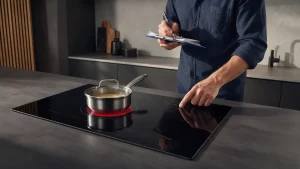
Induction cooking depends on a power module and a coil under each zone, plus sensing that decides whether a pan is present. We test whether the fault follows one zone, whether the pan type matters and whether the controls behave consistently. Heat sinks and fans are checked for airflow, because an overheated module protects itself by shutting down. Pan detection reads how the pan sits on the zone, which is why a warped or undersized base can fail on one zone and work on another.
Surface cooking is hard on equipment. Boil-overs run into burner ports and seep around glass edges. In a small older kitchen the cooktop often sits close to a wall and a hood, so heat builds around it. Where the water is hard, steam residue leaves a crust on caps and trim that can stop them from seating flat. None of this is unusual, and most of it is visible during a quick look.
Induction units also notice how clean their vents are. If a fan intake underneath is clogged by dust from a nearby remodel, the surface may shut itself off to protect the electronics.
Do not pour cleaner into burner ports, and do not pry at the glass edges or trim.
Stop for a gas smell, repeated breaker trips, smoke, a visible crack or a buzz from below the glass. Ventilate the room first when gas is involved. A buzz from below the glass can come from the coil or fan area, so it is a reason to stop rather than to investigate.
When the work is done, we run the repaired zone through a normal cooking cycle while you are there. If a pan, a cap or a habit contributed to the problem, we point it out so it does not come back. The aim is a surface that behaves the same way every time you reach for it.
Cooktops come in gas and induction versions across different widths, and igniters, control boards and coils are specific to each. The rating label is often on the underside, which is hard to reach on an installed unit, so a photo of the manual page or purchase record helps. Our Bertazzoni Cooktops page covers the likely places, and the Bertazzoni PE365INDXV Repair page describes one induction model in detail. A related reading is the Bertazzoni Cooktop E04 Error Code page.
Usually not. A single burner points to its cap, ports or igniter, so that is where the testing starts.
The pan may not be magnetic, may sit off center, or may be too small. If a proper pan still fails, the zone needs testing.
No. Turn it off and stop using it until the glass has been looked at.
Gas and induction cooktops from Bertazzoni fail in different ways, so the type on your counter shapes how a fault gets described.
A zone that answers your touch with E01 and no heat is a start-up problem; here is what gets checked and what you can look at yourself.
E02 that arrives a minute or two into boost with a heavy pan points to a load question; this page covers what gets checked and what is safe to try.
E03 that shuts the whole cooktop down during a busy dinner and clears after a rest tells us a lot about the cause; read what to note and check.
Seeing E04 with a freshly bought pan but not with the old one points to cookware detection; here are the quick checks and when to book.
E05 that follows a spill or a wet wipe near the touch panel is a timing clue; read which checks are safe and when the panel needs a technician.
E06 that appears on the first use after a power cut or breaker flip often follows a supply event; read what to note and what is safe to check.
Cloudy glasses, a puddle at the base or a cycle that dies halfway are different failures, and we sort them by the…
Uneven browning, a slow preheat or a door that stays locked each point to a different part of the oven, and each…
A freestanding range packs burners and an oven into one body, so a fault in one half can look like a fault…
A fridge that drifts warm is a slow-motion problem, so we collect temperature readings before anyone talks about parts or the sealed…
Share a few details and we’ll confirm an appointment. Prefer to talk? Call us and we’ll help right away.