Ovens
Built-in Bertazzoni ovens come as single and double units across three series, and knowing yours helps when something stops heating evenly.
In-home Bertazzoni repair across the San Francisco Bay AreaMon–Sat 8 AM – 7 PM
Burners and oven share one body and one control board on a Bertazzoni range, so we work out which half is really failing before quoting anything.
Repair service · Oven & Range
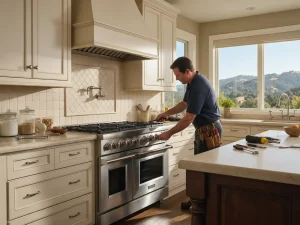
A freestanding Bertazzoni range does the work of a cooktop and a wall oven in a single body. Depending on the model it runs on gas, on a mix of gas burners and an electric oven (dual fuel), or on induction zones over an electric oven. Each version fails in its own ways, and the shared cabinet adds a few extra ones. A freestanding range also sits on the floor with its own feet, so how level it stands can shape both flame and oven door fit.
The practical consequence is that a complaint such as “the range is acting up” has to be split in two before it means anything. Is it the top, the oven, or the part of the machine they both rely on, such as the power feed and the control board?
Describing which half is affected, and whether the oven display still lights, gives the first real division of the problem.
If only the top misbehaves, the oven side stays out of the picture. If both halves are down together, we think about what they share: the supply, the main control and any connector between them. A range that died during a brownout points somewhere very different from one where a single burner has been weak for months.
On gas burners, the usual suspects are caps that sit slightly off, residue in the ports, and the spark path. We look at those before anything involving the gas train. A burner that clicks but will not catch may simply have a cap that is not seated, and the click comes from the spark module sending current to the igniter. Valve and pressure work is for a technician only; it is never a task to attempt at home.
Dual fuel ranges pair gas burners with an electric oven, so the oven is checked like a wall oven: element circuits, probe, fan and latch. Induction ranges add cookware sensing and a power module under the glass, and those are tested with the appropriate instruments. Induction works by a coil under the glass that heats the pan itself, so a zone that ignores the pan may have a pan-detection problem and not a dead coil.
Please leave the back panel, the oven floor and the gas connection alone. Do not hold a knob in to force a spark, and do not use a flame to test the oven pilot-style.
A few moments in a range’s life tend to bring faults to the surface. After a delivery or kitchen remodel, a range that was slid out and pushed back may sit unlevel, which affects flame shape and oven door fit. After a power outage, a control board can restart in a confused state. Very damp coastal air can leave a film on igniters, so burners that worked in September click in a foggy week. A burner that clicks only in damp weather and lights after the igniter dries points at moisture rather than at the spark module.
Tell us about any of those events. They narrow the search quickly.
If you smell gas, shut the supply at the valve, open a window and call your gas utility from outside. Stop using any range that smokes, arcs, trips a breaker or shows damaged cracked glass. Those are not situations for a trial run.
Ranges come in different widths and fuel types, and in Professional, Master and Heritage styling. Burner assemblies, igniters, control boards and oven parts are not interchangeable across that spread. The full number on the rating label tells us which one is in your kitchen.
The label on a freestanding range usually sits along the frame inside the oven door opening, or on the edge of the storage drawer area. Our Bertazzoni Ranges page lists the likely spots. For oven-side complaints, the Bertazzoni Oven Repair and Bertazzoni Cooktop Repair pages describe how each half is handled.
Use the contact page to send the model number, the fuel type, what failed and when. We arrive with matching references, test the half that is failing, and confirm the other half is healthy so you do not hear about it again next month.
You then get a written estimate after diagnosis, and nothing is swapped without your approval. New installs and kitchen remodels are common triggers here: a range that was moved, re-leveled or reconnected can start behaving differently, and we ask about that early.
Both. We test the burner or induction side and the oven side separately, then check what they share.
Yes. Tell us the fuel type and the full model number when you book so the right references are ready.
Not always. Check the breaker first, then tell us what the display and burners do. A recurring problem needs a technician.
A door-lock reading on the display, usually during a cleaning cycle or a long bake, and the checks worth making before anyone opens the oven.
A longer code that appears while the oven is already working, linked to the door lock or the control driving it, and what to note before calling.
When the oven shows E02 the heating side is under suspicion: slow preheat, cool cavity or uneven browning, and what to look at before a visit.
The oven thinks the cavity is hotter or colder than it is. How an E03 sensor reading shows up in baking results, and which checks are safe.
E04 is a general sensor-circuit entry, not a named probe. What owners notice, when it tends to appear, and why a meter is needed to narrow it.
A control-board or communication message that can follow a power event; what to notice and which clues speed a technician up.
Uneven browning, a slow preheat or a door that stays locked each point to a different part of the oven, and each…
A fridge that drifts warm is a slow-motion problem, so we collect temperature readings before anyone talks about parts or the sealed…
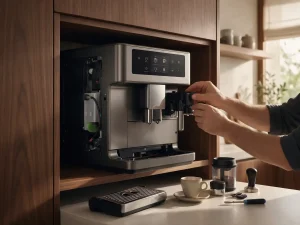
A built-in coffee machine goes through water, grind, heat and brew in a few seconds, and the stage where it stops points…
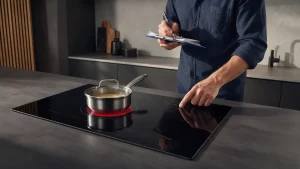
Whether one zone misbehaves or the whole surface is dead decides almost everything about a cooktop repair, so we begin right there.
Share a few details and we’ll confirm an appointment. Prefer to talk? Call us and we’ll help right away.