


In-home Bertazzoni repair across the San Francisco Bay AreaMon–Sat 8 AM – 7 PM
A convection fan that rattles, hums late or stops mid-cycle leaves clues in your baking. Here is what gets measured on site and what you can note beforehand.
Repair guide
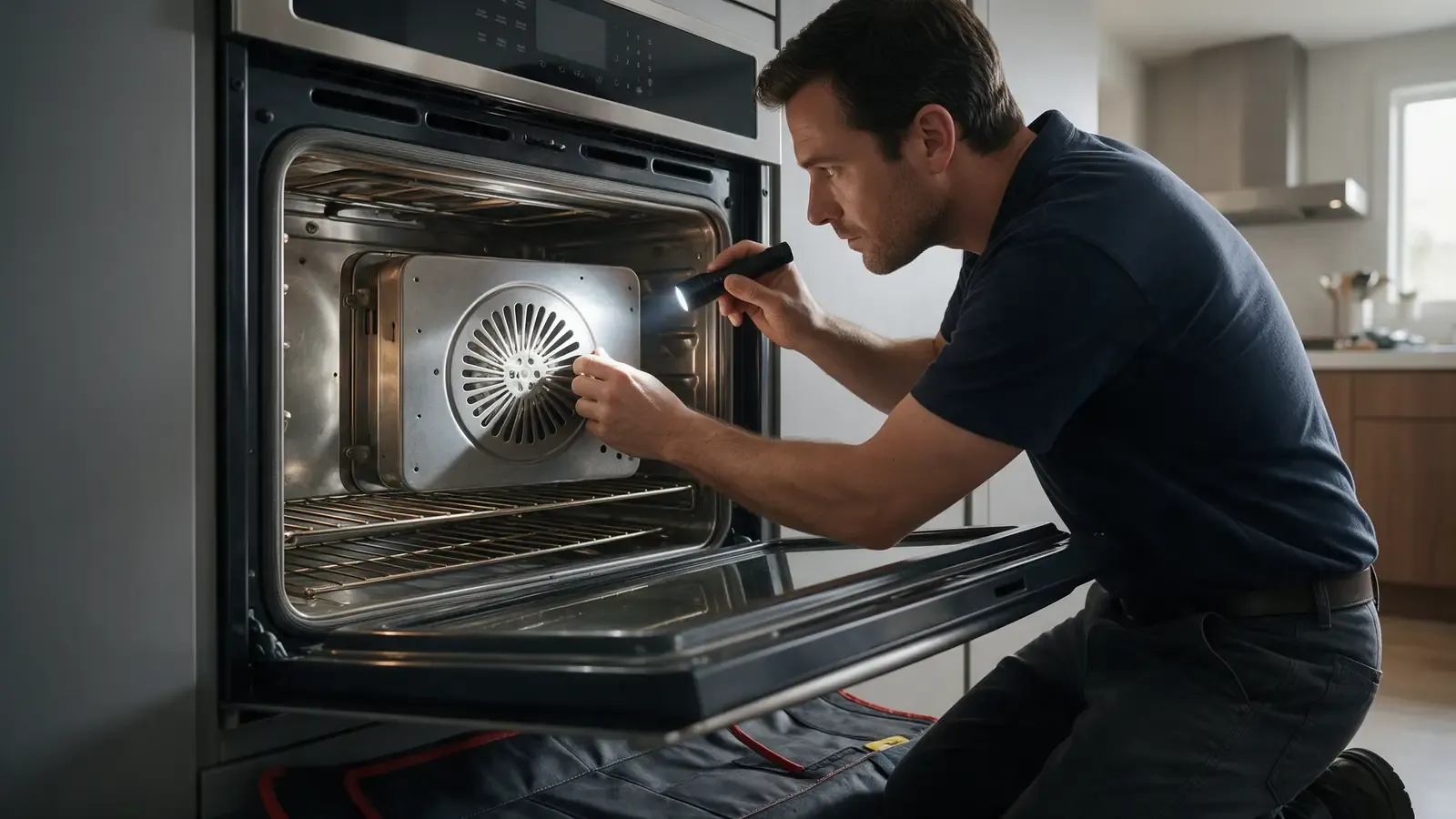
The convection fan sits behind a panel at the back of the oven cavity, so you never see it, but you hear it and you taste what it does. Most owners first notice a change at the stove: a faint whirr that used to disappear into the kitchen is suddenly audible, or the second tray of cookies is pale while the first is done.
In convection modes the fan moves heated air around the cavity so the temperature stays even from rack to rack. Dual-fan models such as the 30-inch MAST30FSEXV use that airflow for roasting, multi-rack baking and fast preheat. In plain bake the fan is usually quiet or idle, which is why a fan problem can hide for weeks and only show when you roast a chicken. A temperature sensor in the cavity reads heat, not airflow, so a normal reading does not prove the air is moving.
The fan is a motor, a shaft, a blade and a short stretch of wiring, all working in a hot, greasy environment. Heat and cooking residue are the usual enemies. Understanding that makes the symptoms easier to sort.
A fan problem rarely announces itself with a fault code. It shows up as sound or as food. Before you call, jot down which of these fits:
The mode, the temperature and how long into the cycle the sound began are the three details a technician will ask for first.
Most fan complaints trace back to one of a handful of conditions. A worn bearing in the motor produces a growl that grows with temperature. A blade that has picked up baked-on grease or a slight bend sets up a wobble that rattles against the cover. A loose blade hub makes a ticking sound and can let the blade drift on its shaft. A drifting blade and a worn bearing can sound alike at first, so listening alone cannot settle which part is at fault. Less often the motor is healthy and the fault is in the wiring or the control output that feeds it.
There is also a mundane cause that has nothing to do with parts: a sheet pan pushed hard against the back wall, or foil draped over the rack, can choke the air path and make a perfectly good fan sound strained.
A tray of plain white bread slices is a cheap fan test. Fill two racks, set a convection mode at a moderate temperature, and toast for the time on the label. When the air is moving, the slices on both racks color at about the same pace and the same side of each tray does not lead. If the back row is dark and the front row pale, or the top rack races ahead, circulation is uneven.
Photograph the trays and note the rack positions. That picture is more useful to a technician than the sentence “it cooks unevenly,” and it separates a fan problem from a door seal or element problem.
Everything an owner should do happens with the oven cool and the door open. Remove foil and oversized pans, slide the racks out and confirm nothing has fallen behind the rear panel opening. Run a convection preheat with the cavity empty and listen from a normal standing position. The empty cavity matters because extra pans change airflow and can hide the pattern. Compare that to a plain bake preheat.
Do not unscrew the rear panel, reach into any vent slots, or try to spin the blade by hand. The fan assembly lives next to heating elements and a dedicated high-voltage supply, and the cover is not a user-serviceable part. If the oven shares a breaker with a recent trip, mention it rather than resetting it repeatedly.
A visit starts with listening, then with numbers. The technician confirms the exact model from the rating label, runs the oven in each mode and compares fan behavior between them. Temperature is logged at several points and several rack positions, so an uneven reading tells whether air is circulating or merely present. Comparing the same rack positions between convection and plain bake shows whether the difference comes from the fan or from the elements.
Once the oven is made safe and the rear panel is off, the blade is inspected for buildup, play and balance, and the shaft is turned to feel for roughness. Supply to the motor is checked under load, which separates a failing motor from a failing control output. Door gasket condition is looked at too, because leaking heat can imitate poor circulation.
Stop using the fan if you smell something hot or electrical, hear metal striking metal, or see the display fault while the fan sounds wrong. Plain bake is usually fine to use gently in the meantime, but the oven should not run convection until it has been looked at, because a scraping blade can damage the cover or the motor further. A noise that appears once and never returns is a different situation from one that repeats at every convection preheat, and the repeating pattern is the one to report.
For a wider overview of what the visit includes, see Bertazzoni Oven Repair. If you also have a cooling problem, the Bertazzoni Ovens page lists related symptoms.
Fans wear faster where ovens work hard and cleaning is skipped. In Bay Area homes that is often the weekend-roast household or the rental unit with a long gap between deep cleans. Cooking grease carried on warm air settles on the blade and slowly unbalances it, so a gentle cavity wipe-down, within the manual, goes further than most people expect. After diagnosis you receive a written estimate and nothing is replaced until you approve it.
Not usually on its own, but a scraping or burning smell means stop using convection mode until it is checked. A fan that is merely louder than before is worth watching, while one that changes pitch or stutters is worth reporting.
Plain bake does not depend on moving air, while roasting and multi-rack cooking do, so a weak fan shows up there first.
No. Reaching it means removing the rear panel next to heating elements and a high-voltage supply, which is a technician task.
No. Buildup, a loose hub, wiring or the control output can cause the same symptom, so measurements come before parts.
The full model number from the label, the mode and temperature in use, when the sound starts, and whether any breaker trips occurred.
Share a few details and we’ll confirm an appointment. Prefer to talk? Call us and we’ll help right away.