


In-home Bertazzoni repair across the San Francisco Bay AreaMon–Sat 8 AM – 7 PM
Many induction zone complaints end at the pan, not the glass. These quick checks show whether cookware is the cause before anyone opens the cooktop.
Repair guide
Induction cooktops do not warm the glass and hope the pan picks up the heat. They create a magnetic field and the pan itself becomes the heating element. If the pan cannot respond to that field in the right way, the zone does what it was designed to do and refuses to run, which looks exactly like a fault. Pan detection is a protective step, so a zone that stays dark with unsuitable cookware is behaving normally, while a zone that stays dark with the right cookware is the one worth investigating.
The typical story is a zone that lights up, flashes a symbol or number, beeps, and then shuts down. Sometimes it heats weakly or cycles on and off every few seconds. Another common version is that a favorite pot worked for years and then stopped after a replacement set arrived. A zone that ignores one pan but runs another on the same spot is nearly always telling you about the pan.
On a 36-inch five-zone cooktop such as the PE365INDXV, the quickest sorting question is simple: does the trouble travel along with the pot, or does it remain on that one spot of glass?
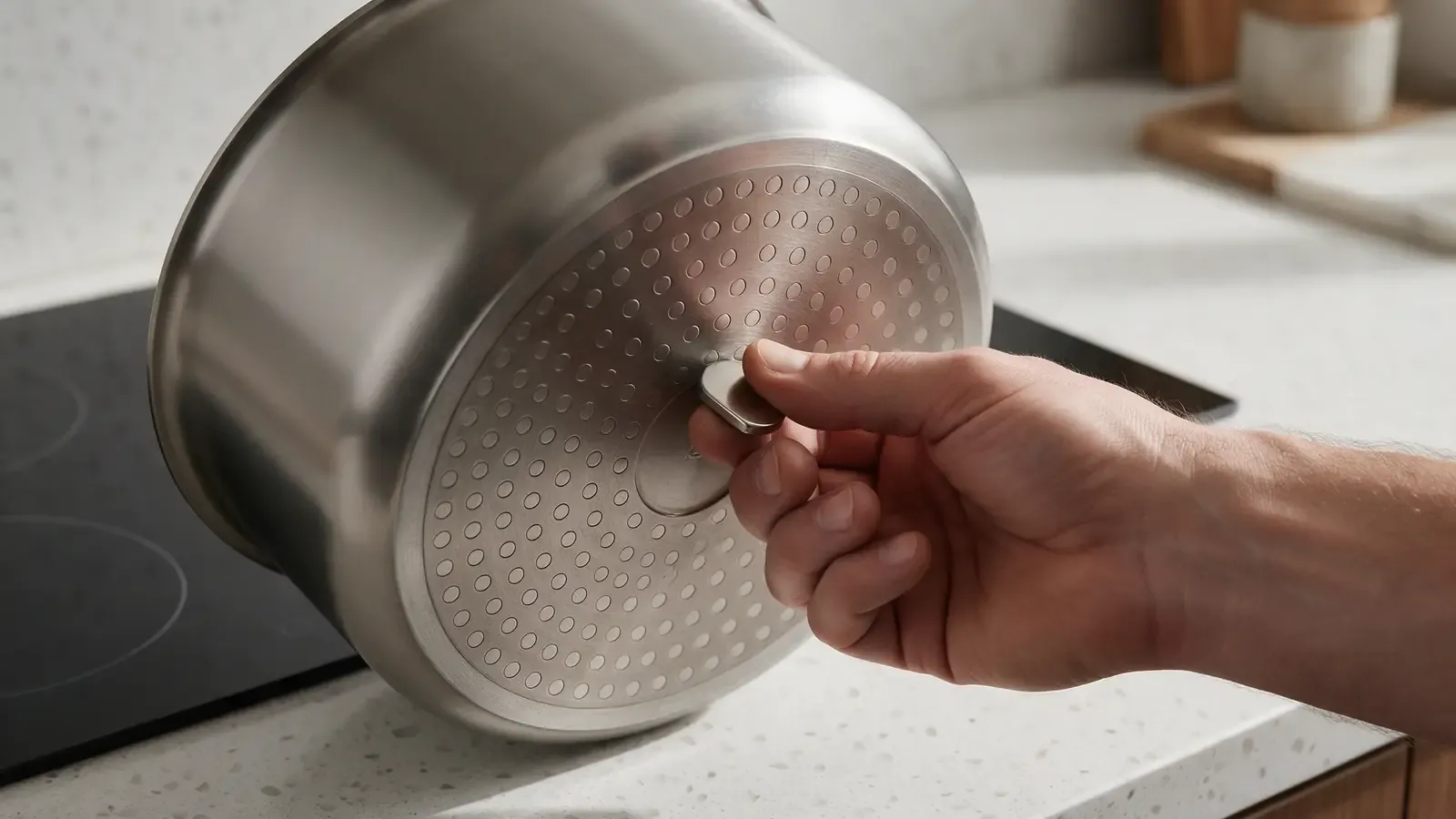
Hold a refrigerator magnet to the underside of the pot. A firm grab suggests a ferromagnetic base, which is a good start. A weak or sliding attachment points to a base that induction will handle poorly or not at all.
The magnet does not tell the whole story. Some pots are stainless on the outside with an aluminum core that is not magnetic across the whole base, and some are layered in a way that only partly responds. A pan can pass the magnet check and still run unevenly because the magnetic layer is small or thin. Treat the magnet as a filter, not a pass certificate. If the base is only partly magnetic, the zone may detect the pan one moment and lose it the next, which shows up as the on-and-off cycling described earlier.
Every zone has a detection area. A very small pan, such as a butter warmer, may sit below the minimum the zone will recognize. A pan much wider than the zone also works poorly because part of the base lies outside the field.
Three things are worth confirming right at the stove.
A warped pan rocks on a flat counter. It will rock on the glass as well, and the zone may read the air gap as no pan present. Laying a straightedge across the base is an easy way to see whether it is truly flat.
Thin-based pans often overheat and trigger protective shutdowns because the base cannot spread the energy. Cast iron with a rough base can scratch the glass and heat unevenly. Pans with a foil-wrapped or disc-bonded base sometimes separate after long use, leaving a hollow that hums or buzzes. Glass, aluminum alone, copper alone and pure ceramic will not work unless the manufacturer added a magnetic disc.
A buzzing, humming or clicking sound at higher power levels is common with some bases and is not by itself a sign of damage. A sound that appears with one pot and vanishes with another points at that pot.
Switch the cooktop off, let any residual heat indicator clear, and wipe the glass with a soft damp cloth. Spilled sugar, dried milk or a stuck-on label from a new pan can interfere. Check that the control lock is not engaged, since a locked panel looks like a dead zone. Try the same pan on a second zone and a second pan on the first zone. The manual for the exact model shows how the control lock is turned off and what its indicator looks like.
Do not lift or remove the cooktop, lean on the glass, or open anything underneath it. The appliance is on a high-power dedicated circuit, and the work area under the glass is a technician matter. For the wider picture, see Bertazzoni Cooktops.
Order matters, because each step rules something out. Start by cleaning the glass and the pan base so neither hides a problem. Put the pan you believe in on the zone that failed, centered, and select a middle power level. Wait a full minute, since some zones take a moment to detect the pan and ramp up.
Next move that same pan to a different zone of similar size. If it heats there, the pan is fine and the first zone needs attention. If it fails everywhere, the pan is the culprit. Finally, try a second pan you know is magnetic, such as a cast iron skillet, on the first zone. Two pans failing on one zone while both work elsewhere is the pattern that justifies a service visit.
Write down what the display showed on each attempt. A fast flash and shutdown, a steady error symbol and a zone that never lights are three different stories.
Remodels in San Francisco, Oakland and across the peninsula often replace a gas cooktop with induction, and the old pots come along. Many households keep a mix of aluminum, copper-bottom and enameled pieces, and a fraction of those will not work. The switch also exposes warped pans that sat flat enough on a grate but not on glass. A new induction cooktop can look faulty in its first week purely because the cookware was never tested for it.
If three different known-good magnetic pans fail on the same zone while they work on other zones, stop testing and note the exact display, whether any code appears, and what the cooling fan does. At that point the question moves to the power module, the coil, a temperature sensor or the control, and the right step is measurement rather than more experiments. A shutdown that returns on one zone in the same pattern tells us something different from a one-off event after a power flicker, so mention which of the two you saw. Bertazzoni Cooktop Repair describes how that visit works.
A repair estimate is given in writing after diagnosis, and nothing is replaced without your approval. If your pans pass every check, the visit will usually start with the zone you identified, which is the shortest path to an answer.
Not always. Stainless varies by grade and construction, so use a magnet on the base and look for an induction symbol when buying.
The zone may not detect the pan because of size, a warped base or non-magnetic material, so it stops as designed.
Some pans hum or buzz at higher power levels. If the sound follows the pan from zone to zone, the cookware is the cause.
When several magnetic, flat, correctly sized pans all fail on one zone but work on others, the zone should be measured.
No. Leave it installed unless the technician asks otherwise.
Share a few details and we’ll confirm an appointment. Prefer to talk? Call us and we’ll help right away.