


In-home Bertazzoni repair across the San Francisco Bay AreaMon–Sat 8 AM – 7 PM
The clicking will not stop and no flame appears. Often that points to a dirty cap or moisture, but gas needs caution, so know the line between a check and a call.
Repair guide
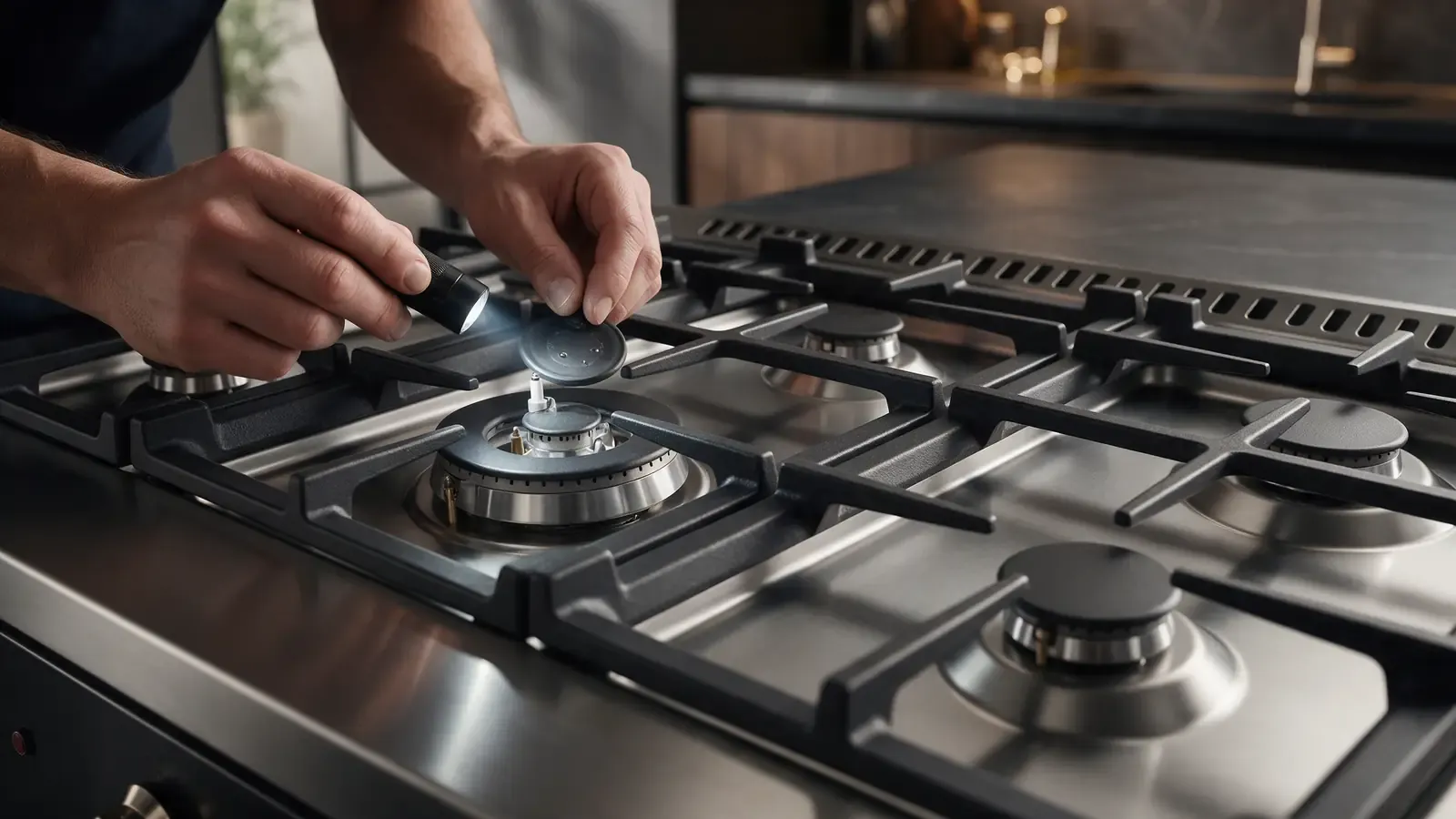
The spark ignition system makes a click every time it tries to ignite gas at a burner. If you hear clicking, the electrical side of the system is producing sparks. The question becomes whether gas and spark meet at the same place at the same time. The spark electrode is the small ceramic-tipped part beside the burner head, and it only works when its tip is clean and dry.
A continuous click that carries on after the burner has lit means something else: moisture or residue near the spark electrode, or a switch stuck in the on position. Both are different stories, so notice whether the burner eventually lights, lights then goes out, or never lights. Each pattern points toward a different part of the system, so the order of events is useful.
Say which burner, since a single-burner problem looks very different from every burner clicking at once.
If you smell gas at any point, stop. Do not use switches or flames, leave the house, and call your gas utility from outside. A technician visit comes after the gas company confirms the home is safe.
If you do not smell gas but a burner clicks for a long time without lighting, turn that burner knob to off. Letting it click while gas flows risks a delayed ignition. Wait several minutes for any unburned gas to disperse before trying again. Gas that has not burned can collect near the cooktop, which is why waiting matters more than retrying quickly.
Do not try to light the burner with a match during an outage unless your manual explicitly instructs it for your model, and keep the room ventilated.
The overwhelming number of cases involve something simple. The burner cap is sitting crooked after cleaning, the burner head is not seated on its base, or the igniter electrode is wet or crusted with boiled-over food. Sugar-based spills are especially stubborn. A cap that looks seated can still sit slightly off its alignment, which moves the flame away from the electrode.
Coastal humidity matters here. After a week of fog or a heavy rain, moisture can ride in on the burner parts, and the spark may arc to the wrong place. Parts that were washed and not fully dried act the same way.
Clogged burner ports also cause trouble, because gas cannot reach the flame area evenly. A burner that lights on one side and not the other, or that lights with a pop, often points here.
If a burner still clicks without lighting after this, stop and call. Do not adjust anything beneath the cooktop surface. The parts under the surface carry gas and mains power, so inspection there belongs to a technician.
When the cleaning does not help, the technician checks the spark electrode for cracks or wear, the ignition module, the wiring and the burner valve. Some cases involve a worn electrode that sparks weakly, while others stem from a module that sends spark to every electrode when only one is called. The ignition module is the control that sends spark to the burners, so its behavior is checked together with the wiring.
The cooktop E19 code page describes how ignition-related messages are treated. Gas pressure and regulator work is always a technician matter, never something to adjust at home.
The result is a written estimate with the findings explained. No part is replaced until you agree.
If every burner clicks continuously at once, it points to the ignition module or a switch rather than a single dirty burner. That is common after a spill reaches the control area or after a power event.
A cooktop that clicks on its own with no knob turned also needs attention. Turn the circuit off at the breaker and leave it off until a technician has looked at it. Moisture near the switches is a typical cause in kitchens near the coast.
Mention whether the clicking began after cleaning, a boil-over, or a wet-weather stretch. That pattern is highly informative.
Many calls follow the first heavy rain after a dry summer, or a stretch of thick marine fog. Moisture settles inside burner bases and around electrodes, and the spark finds an easier path to ground than the intended gap. That is why the same burner can behave differently from morning to afternoon. The burner clicks, nothing lights, and an hour later it lights perfectly.
Pot boil-overs create the same effect more directly. Sugary liquid runs into the burner base, dries into a conductive crust and keeps the electrode from sparking correctly. Cleaning removes it, but only if the parts are fully dry before you reassemble.
If a burner works only after you have left it clicking for a minute, do not make that a routine. Clean and dry the parts so it lights quickly.
Gas cooktops still need electricity for ignition. After a power outage, burners that light with a spark will not light, and when power returns they may click rapidly while the system settles. Switch off all knobs first, then restore power, then try one burner at a time.
If you live in an area with frequent planned outages, ask your technician whether your model offers any safe procedure for lighting during an outage. Never improvise with the unit open. A burner that lights normally with power on and not at all without it is behaving as designed.
A burner that clicks only when other appliances start, or when the lights dim, may be reflecting a household wiring issue instead of a faulty cooktop. Mention it.
Shut off and call if you smell gas, see flames lifting off the burner, hear a loud pop on ignition, or notice yellow tips and soot. Also call when a clean, dry burner still refuses to light.
For the service itself, see Bertazzoni cooktop repair and the overview of Bertazzoni cooktops. If your range has an oven alongside, Bertazzoni range repair covers the full unit.
Not by itself, but if gas is flowing without a flame it can be. Turn the knob off and ventilate before trying again.
A cap that is crooked or parts that are still damp are the usual reasons. Reseat and dry thoroughly.
No. Gas adjustment is a technician task and never a homeowner step.
That points to that burner assembly or its electrode, and is usually easier to resolve than a whole-cooktop issue.
Share a few details and we’ll confirm an appointment. Prefer to talk? Call us and we’ll help right away.