


In-home Bertazzoni repair across the San Francisco Bay AreaMon–Sat 8 AM – 7 PM
A refrigerator should rest between cycles. When the hum never stops, the question is whether it is working too hard or not cooling well.
Repair guide
Refrigerators cycle on and off through the day. In a hot kitchen, after a grocery trip, or just after a defrost cycle, the run times lengthen. Running continuously for an hour or two after loading is not unusual.
The abnormal case is a unit that never stops for most of a day, with the interior drifting warm or the freezer frosting up. That pattern says the cooling cannot keep up, and the control has no reason to switch off. In plain terms, the cooling is working as hard as it can and still falling behind.
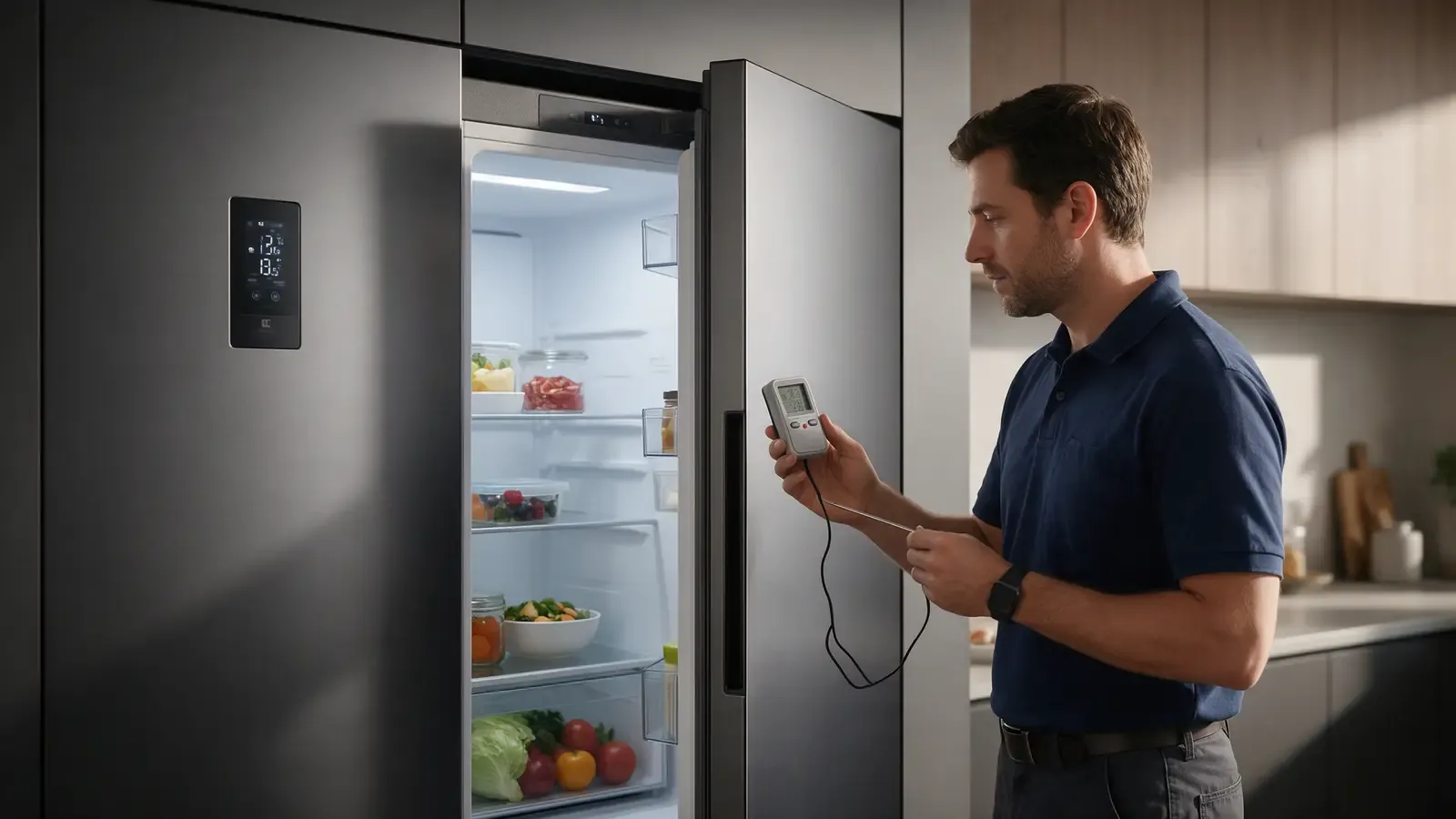
Notice the interior temperature with a thermometer. A unit that runs constantly but holds temperature is a different problem from one that runs constantly and cannot cool.
Warm kitchens force longer runs. Inland during a heat wave, kitchen temperatures can climb well above the range for which a fridge is rated, and the unit runs almost continuously. A south-facing wall, an oven used for hours or a closed-up apartment adds to it.
Placement inside cabinetry matters too. A built-in that is boxed in has trouble shedding heat, and constant running is the early symptom. Ventilation openings around the cabinet are there so heat can leave the unit, and blocking them keeps that heat trapped around the condenser. See our guide on airflow in older homes for how this plays out.
Dust-covered condenser coils reject heat poorly. Pets and carpet make this worse. A visible grille cleaning may help.
A poor door seal leaks warm air in constantly, and the compressor chases it. Overloaded shelves block cold air circulation, and a freezer packed solid to the walls prevents airflow. Hot dishes put into the fridge create extra load. A gasket that is torn, stiff or wavy can leave a gap along one edge of the door that shows up in the paper test.
The gasket paper test explains the method.
Frost on the evaporator restricts airflow and cooling. The compressor runs on trying to reach temperature while the coil is coated. A fan that runs slowly gives the same result. The defrost cycle is meant to melt that frost periodically, so frost that keeps returning raises the question of whether the defrost components are working. This links to the guide on frost build-up.
A temperature sensor that reads wrong can keep the system running because it believes the compartment is warm. Similarly, a control that misses its shutoff signal keeps the compressor on. Neither fault is visible from outside, which is why temperatures are measured instead of guessing from the sound of the compressor.
Refrigerator E01 describes how compartment sensor faults are treated for this family.
The cold itself is made in a sealed system holding refrigerant. A loss of refrigerant or a weak compressor yields constant running with poor cooling. These are real failures, but they are late in the list because simpler causes are far more common.
Owners must not touch refrigerant lines or any sealed component. The work requires specialized equipment, and mistakes are both dangerous and expensive.
A technician tests for these only after eliminating the easier causes through measurements.
Temperatures are logged inside the compartments and at the condenser airflow path, so the technician can see whether the unit is struggling or simply overloaded. Fan operation, defrost components and sensor values are tested, along with the door seals.
Running current of the compressor is compared with expected values to judge its health. After diagnosis, you get a plain explanation and a written estimate, and approval is yours before parts are replaced.
Bring the model number and a log of interior temperatures over a day, if you can.
If the interior stays above 40 degrees for several hours, move perishables to a cooler with ice. Keep the door closed as much as possible and avoid opening it just to check. A freezer that is still solid is holding temperature, and its contents are safe as long as they have not thawed.
Do not switch the unit on and off repeatedly. After a power-off, wait several minutes before restarting to let pressures settle, as manuals usually advise.
If the fridge is warm, humming constantly and the back is hot, call without delay.
You can learn a lot without tools. Put a thermometer in a glass of water on a middle shelf and another in the freezer, then read them morning, noon and night. Listen at those same times to whether the compressor is on.
A unit that runs constantly and holds a steady 37 degrees is simply working hard, probably against heat or a leaking seal. A unit that runs constantly while the temperature climbs is losing the cooling battle, which is more serious.
Write the readings with times. This record helps rule out coincidence, such as someone leaving the door ajar overnight.
After an outage, the compressor and fans take a while to recover, and the interior may need hours to return to normal. A fridge that runs hard for a half day afterward is behaving sensibly if the door was kept shut.
Brief power dips, which are common in storm season, can interrupt the compressor mid-cycle and force a delayed restart. If you notice the unit clicking off and on at odd times, mention it to the technician. A short pause before the compressor restarts is not a fault by itself; repeated odd cycling is worth reporting.
Plugging the unit into a power strip or extension cord is a common mistake. Built-in refrigerators belong on their intended dedicated outlet, and an adapter can cause voltage drop.
Call when the compressor runs for most of a day, the interior is warm, you hear clicking at startup that repeats, or water or ice builds up. See Bertazzoni refrigerator repair for how service works.
Long runs strain it, especially if cooling is poor. Finding the cause early protects the compressor.
The compressor is running but not removing heat effectively, often due to airflow, frost, or sealed-system problems.
You can vacuum accessible grilles. Do not pull the unit out or remove panels yourself.
A short power-off is fine, but let it rest several minutes before restarting.
Share a few details and we’ll confirm an appointment. Prefer to talk? Call us and we’ll help right away.