


In-home Bertazzoni repair across the San Francisco Bay AreaMon–Sat 8 AM – 7 PM
Older kitchens were not designed around a tall built-in fridge. Tight cabinet gaps and warm walls can quietly choke ventilation and shorten its life.
Repair guide
Victorians in the Haight, bungalows in Oakland and Berkeley, and mid-century homes in San Mateo share a habit: kitchens were carved out of whatever space existed. When a tall built-in column goes into an opening framed decades ago, the planned ventilation gap is often smaller than it should be, or filled by new trim.
The condenser sheds the heat taken out of the cabinet, and it needs air moving past it to do that. When the surrounding air is already warm, the compressor runs longer to reach the same temperature.
Panel-ready columns are especially exposed. Beautiful cabinetry closes in on the sides and top, and the fridge has nowhere to push its warm air. The result is a compressor and condenser running in a hot pocket. The cabinet does not fail outright, it simply works harder every day, so the change tends to be gradual.
It is the same appliance that works perfectly in a new-build kitchen, which is why owners are surprised when it struggles in a remodel.
The pattern is usually slow. The fridge runs longer than before, the cabinet sides or the toe-kick area feel warm to the hand, and the motor sound becomes more constant. In summer, especially during inland heat waves, temperatures inside may creep up in the afternoon and recover overnight.
Time of day is a strong clue. A restriction that only matters when the kitchen is hot is a ventilation problem, not a sealed-system failure.
A warm interior with cool cabinet sides leans away from airflow, while hot sides lean toward it, though neither observation settles the question alone.
The usual culprits are mundane. Trim or a crown molding piece was added over the top vent. A cabinet filler strip closed the side gap. A pantry shelf was built up against the toe-kick grille. Insulation or dust packed behind the unit over years.
Another one in older homes is the adjacent heat source. A range, a dishwasher, or a wall that backs onto a furnace closet pours warmth next to the fridge. The unit then has to reject heat into air that is already warm.
None of these involve a faulty part. They are installation realities, and they can be corrected without replacing anything inside the refrigerator.
Look at the toe-kick grille and the top of the cabinet. Both should be open to airflow, not blocked by trim, boxes or stored items. Feel the sides of the cabinet after the fridge has run for an hour; mild warmth is normal, hot is not.
Measure the gap between the fridge and the nearest panel and compare it with the spacing in your installation manual. If the manual is gone, the model number gets you a copy.
Clean the visible grille with a vacuum brush attachment, but do not pull the unit from the wall by yourself. These columns are heavy, water line and power cord are connected behind them, and tipping one is a real injury risk.
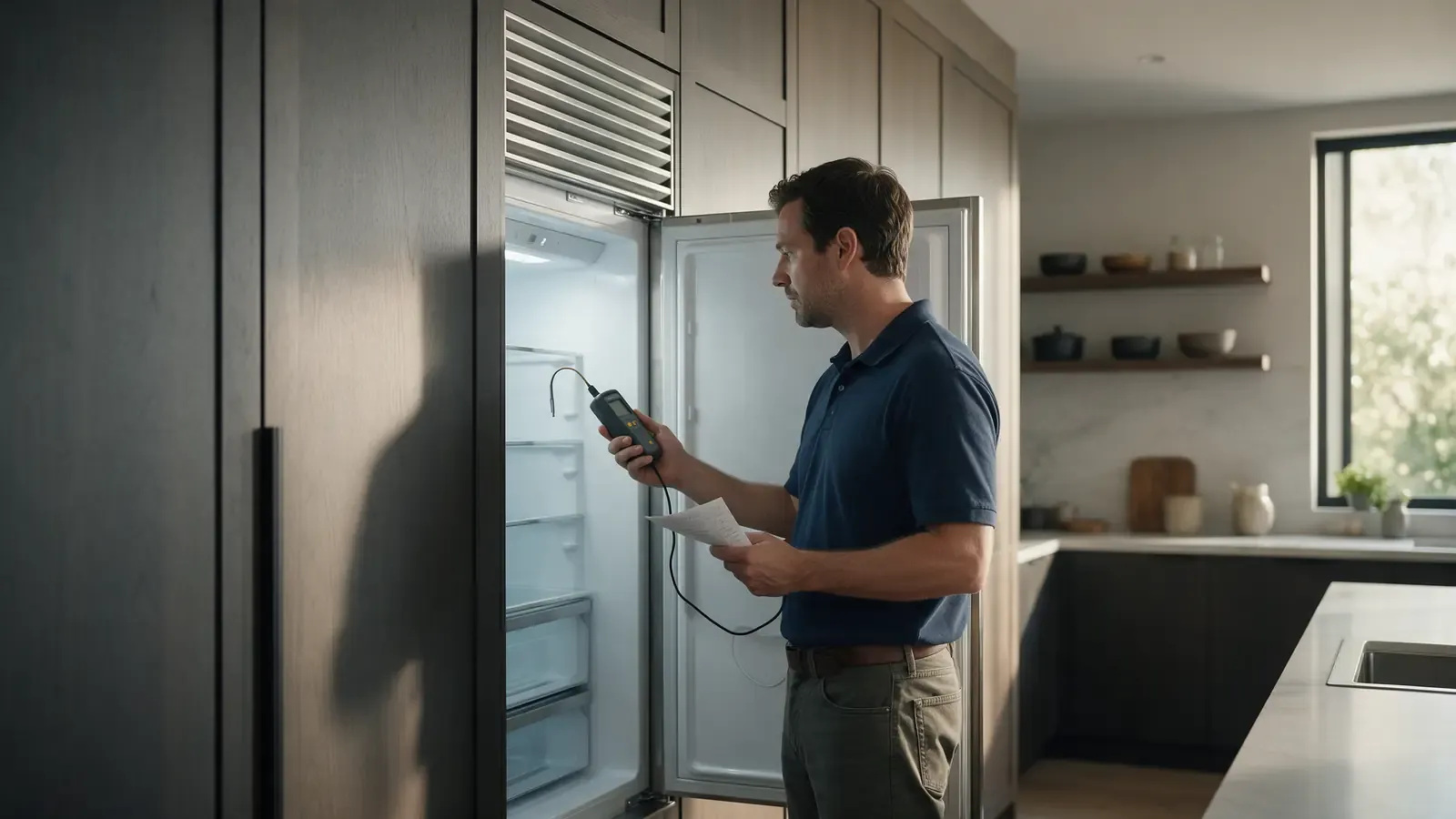
On a visit, the technician records interior temperature at several points over time, checks condenser and evaporator fan operation, and measures how warm the surrounding cabinet air becomes. Door seals and the defrost cycle are checked too, because they can imitate an airflow problem. The condenser fan and evaporator fan serve different jobs, so each is observed separately.
If the evaluation shows the sealed system itself is healthy, the fix is clearance, not parts. If clearance is fine and temperatures still drift, the fan, sensor or control become suspects. See refrigerator E07 for how evaporator fan faults are treated on this family.
Written estimates come before work, and parts are only replaced with your approval.
Look at the whole situation, not only the appliance. A column that sits beside a south-facing window in a San Jose afternoon or a kitchen with no cross-ventilation faces a harder job than one in a cool north-side room. Heat from the room is heat the condenser must fight.
Check what lives next to it. A wall oven stack, a dishwasher, a heating duct register or a water heater closet all radiate warmth. Even the finish of the cabinetry matters; solid panels hold heat that open grilles release.
If you are planning a remodel, ask the installer to preserve the original ventilation openings and to leave a pathway for air to leave the top of the cabinet. It is far easier to plan than to fix later.
Not every warm fridge is a ventilation story. If temperature problems appear in the cold of January as readily as in a July heat wave, restricted airflow is less likely. Frost patterns inside, a door that does not close firmly, or a display message about a fan or sensor point elsewhere.
A gasket that no longer seals can warm the interior while the compressor works overtime, producing the same warm sides and constant running. Condensation along the door edge is a visible clue that room air is getting in. Our guide on the gasket paper test shows a simple way to check the door seal without any tools.
Separating these causes is the whole point of a measured visit, and it keeps you from replacing parts that were never at fault.
Replacement is rarely the right first answer for a column that is simply boxed in. Correcting airflow costs far less than a new appliance, and a new unit installed in the same tight opening would suffer the same issue.
Replacement starts to make sense when repeated temperature complaints persist even after ventilation is corrected, or when the sealed system has failed. Sealed-system work is not for owners and should never be attempted at home.
Stop relying on the fridge for food if the interior stays above safe temperatures for several hours. For the service path, see Bertazzoni refrigerator repair and the guide to column sensor placement.
It depends on the model, so check the installation manual for your model number rather than relying on a general figure.
Mild warmth is expected. Heat you cannot comfortably keep your hand on suggests restricted airflow.
It can reduce them in practice. Added trim or filler panels often block the intended airflow paths.
Not on your own. Columns are heavy and connected to power and water, so leave that to a technician.
Share a few details and we’ll confirm an appointment. Prefer to talk? Call us and we’ll help right away.