


In-home Bertazzoni repair across the San Francisco Bay AreaMon–Sat 8 AM – 7 PM
There is no single right number of weeks. A couple cooking for two and a family of six need different rhythms, and water type shifts it again.
Repair guide
Advice that says clean the filter once a month sounds tidy, but a household that runs the dishwasher once a day produces far more residue than one that runs it twice a week. A filter that gets one dinner party of greasy platters needs attention sooner than the rest of the month suggests.
What matters is the load on the filter: how much food reaches it, how much grease coats it, and how much hard-water scale hardens on it. Three different signals are worth watching, and they are easier to notice than a calendar entry. Because every kitchen differs, the filter itself is the most reliable gauge of when it needs attention.
Build the rhythm from signals, then use a calendar only as a backstop.
Any one of these is a prompt to pull the filter and look. Make a habit of glancing at it whenever you remove the lower rack for another reason, since a quick look takes seconds.
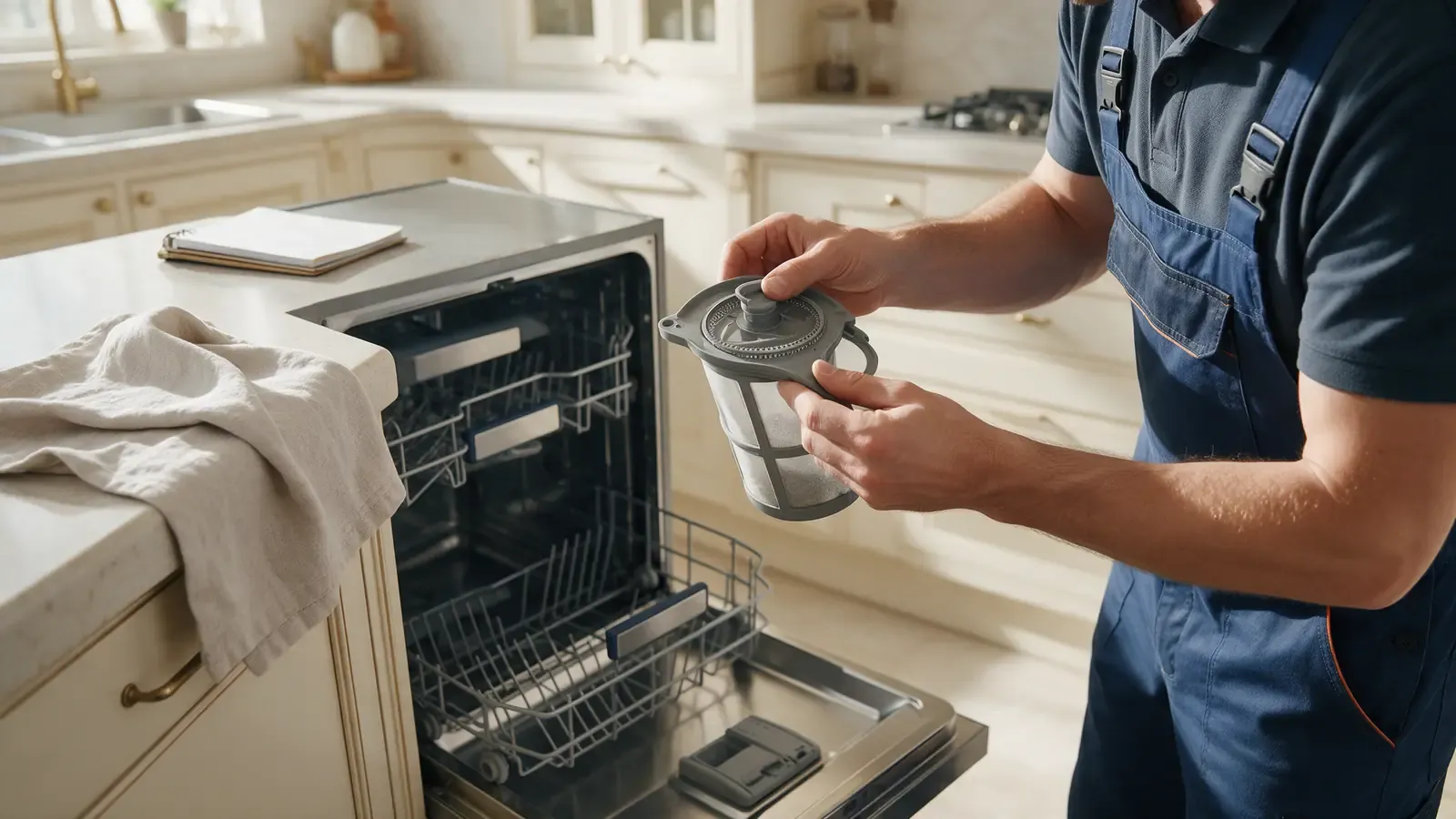
Daily users with a family tend to benefit from a rinse every two weeks, with a deeper clean monthly. Couples and singles who run a cycle every other day can stretch to a monthly rinse. Weekend-heavy households, who run several loads after hosting, should rinse right after the busy stretch. The filter keeps larger debris out of the drain pump, so a heavy load of soil is better dealt with before it reaches that point.
Scraping habits shift everything. Pre-rinsing sends less to the filter, but modern machines expect some soil in order to adjust the cycle. A quick scrape, not a full rinse, is the balance for most kitchens.
These are starting points, not rules. If your signals show up early, shorten the interval. If the filter looks clean on three checks in a row, lengthen it.
Water varies across the region. Parts of San Francisco and the Peninsula are served by soft, mountain-sourced water, while inland and some East Bay and South Bay areas receive harder supplies. Harder water leaves mineral film on the filter mesh that rinsing alone does not remove.
In harder-water homes, an occasional soak in a vinegar and water solution, as your manual permits, loosens that film. Soft-water homes face less scale but more soap film, so a gentle brush and less detergent is the lever.
A cloudy cast on glassware after a clean filter usually points to detergent and water balance, not the filter itself.
Do not use abrasive pads or hard-bristled brushes, and do not run the machine without the filter fitted. Wear gloves if broken glass is a concern. Check that the filter locks fully into place, because a filter sitting loose can let debris past into the drain path.
Scrape plates into the compost or trash, then load. Run the sink hot for a moment before starting a cycle, so the first fill is warm. Use the right dose of detergent for your water.
If you also run a garbage disposal, flush it before the dishwasher starts. Some units share a drain path, and a clogged disposal can slow dishwasher drainage even when the filter is clean. The guide on drain stalls covers that situation.
Keep a small brush near the sink so the job takes a minute, not an event.
A dishwasher that sits unused for two weeks, such as during a summer trip, can develop a smell from water left in the sump. Clean the filter on your return, and run a hot rinse with nothing but the machine empty. The first load after a long gap often shows the most residue. A musty smell that remains after the filter is cleaned and the sump looks clear is worth mentioning, since the drain path may hold water elsewhere.
Conversely, a household that runs the machine twice a day after a new baby or house guests arrive should shorten the interval for those weeks. Rhythm should follow life, not the other way around.
A reminder on the phone for when the schedule changes is more useful than a rigid recurring alert that gets ignored.
A thin layer of soft food is normal. Chunks of food, labels, tiny shards of glass or broken pieces of plastic are not and should change how you load. A clump of paper label suggests jar labels are being washed in, which clog the filter and the pump over time.
If you see bits of glass in the filter more than once, check that glasses are not touching each other or the arms during the cycle. Chipping glass is a sign of heavy collisions, and a spray arm that hits items needs a look.
Keep a note of unusual findings. A technician can tell a great deal from a description like grit in the filter every week, since it hints at a failing component or a water issue.
If a freshly cleaned filter does not resolve water sitting in the tub, noise, or poor wash results, the cause lies deeper. Drain pumps, spray arms and sensors each have their own tests. See spray arm movement for another no-tools check.
For anything that continues, see Bertazzoni dishwasher repair. A written estimate precedes repairs, and approval is yours to give.
Start with every two to four weeks and adjust based on smell, film and water in the sump.
No. Without it, debris reaches the pump and spray arms.
Yes. Mineral film builds faster, so a periodic soak as your manual allows helps.
Often, but a drain problem can also cause it. Clean the filter first and check the sump.
Lift pieces out carefully by hand with gloves and look at how glasses are loaded. If it keeps happening, mention it when you ask for a visit so the spray arms can be checked.
Share a few details and we’ll confirm an appointment. Prefer to talk? Call us and we’ll help right away.