


In-home Bertazzoni repair across the San Francisco Bay AreaMon–Sat 8 AM – 7 PM
A latched door after cleaning is often the oven doing exactly what it should. Cooling takes longer than most people expect, and a few signs separate patience from a fault.
Repair guide
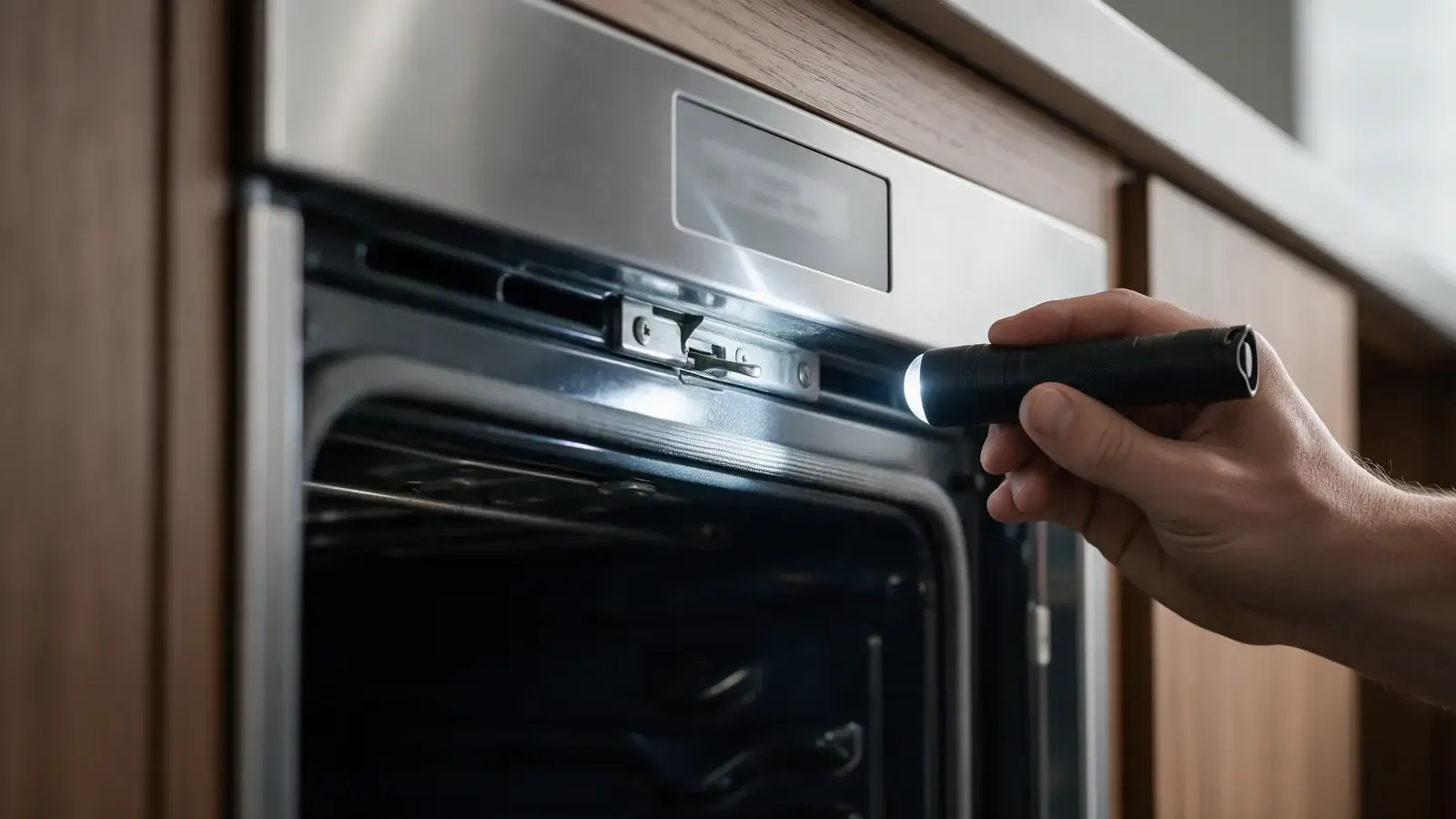
During self-clean the cavity rises far above normal baking temperatures to burn residue to ash. The door latch engages so nobody can open the oven into that heat. It releases only when the control believes the cavity is cool enough, or when its sensors say it is safe.
That means the end of the program and the release of the latch are not the same moment. The timer finishing signals the heating stage is over. The cooling stage that follows can take another hour or more, depending on how hot the cavity became and how warm your kitchen is. Some of that wait is the oven simply shedding heat and some is the control confirming it through its sensors, so the lock can outlast the visible warmth.
So a door that stays locked right after the cycle is not an immediate sign of trouble. Give it time and watch for a lock indicator on the display.
A useful rule is to wait until the cavity feels merely warm when you hold a hand near the door glass, not touching it. In a cool coastal kitchen that may happen sooner. On a hot inland afternoon, with the kitchen already warm, the same oven takes noticeably longer to shed heat.
If an hour or so passes after the cycle ends and the lock indicator is still on, switch the oven off at the control and leave it. Do not repeat the cycle and do not press hard on the handle.
A lock that stays engaged overnight, long after the oven is cold to the touch, is no longer normal. That is the point to describe the behavior to a technician and treat it as a latch or sensing question.
The latch is a small motor-driven mechanism with a position switch. If the switch does not report unlocked, the control will keep it shut as a precaution. Residue, heat fatigue in the mechanism, a failing switch or a sensor reading that is stuck high can all cause that. The position switch is the part the control trusts, so a latch that moves normally can still stay shut if the switch report never arrives.
A long or heavy-duty cycle on a very dirty oven stresses the latch more than a light cleaning does. So does interrupting the cycle with a power outage, which leaves the control uncertain about the state of the lock. In that case it may take a reset to restore normal logic.
If your display shows a door or latch message, the oven E12 code page explains how those readings are handled on this family.
Never pry at the door, tap on the latch with a tool, or use a hair dryer or fan to speed cooling. Forcing a locked door can break the hinge or glass and does nothing for the latch itself.
The technician watches the latch move through its cycle and compares what the control commands with what the position switch reports. The motor, the switch and the wiring to them are examined, and sensor readings are checked to rule out a stuck-hot value. That comparison separates a mechanical latch problem from a control or sensor reading, which can look identical from the outside.
Because the latch is exposed to heat, the surrounding area is inspected for heat damage or residue. Where a latch must be replaced, the written estimate states why and the work waits for your approval. Nothing is replaced on assumption.
Tell the technician how often you self-clean and whether a cycle was ever interrupted. Both details speed the diagnosis.
Wipe spills when the oven is cool, before they bake on. Remove racks and loose crumbs first, as your manual directs. A lightly soiled oven needs a shorter, gentler cycle, and it cools faster. A lightly soiled oven also leaves less residue around the latch opening, so the mechanism is less likely to be affected.
Many owners in foggy neighborhoods run self-clean in the evening and find the door locked the next morning. That is usually fine. Others in the Valley run it on a hot afternoon, then wonder why it still is not unlocked at dinner. Match the timing to your kitchen temperature.
Open a window and run the vent for ventilation. Smoke from heavy residue is normal, but pets and birds are sensitive to fumes, so keep them out of the kitchen.
Self-clean is the one oven mode where an interruption really matters. If the lights flicker or the breaker drops partway through, the cavity may be extremely hot with the latch engaged and the control starting from a blank state. Many ovens then hold the lock until they confirm the temperature, which can take a long while. The control cannot see the lock position reliably straight after an outage, so holding it shut is the cautious default rather than proof that something broke.
Resist the temptation to switch the oven on and off repeatedly to get it to reset. Turn it off, give it plenty of time, and only then restore power. A cold oven that still reports a hot cavity points to a sensor, not a lock problem.
If the household circuit trips during self-clean on more than one occasion, stop running the cycle and mention that when you book, because the element or wiring may be drawing more than it should.
A strong smell during and just after self-clean is normal for a heavily soiled oven, but it should fade as the cavity cools. If the smell is sharp or chemical, or the smoke alarm sounds repeatedly, stop the cycle and let the oven cool with the door closed and the vent running.
In compact kitchens common in older Bay Area apartments, ventilation is limited and the smell lingers. Open a window across from the oven if you can, and keep cabinet doors nearby closed so the fumes do not settle in them.
If the kitchen counters next to the oven warm noticeably during the cycle, check that nothing flammable sits beside the door, and keep towels and mitts well away.
Switch the oven off and call if you smell burning plastic, see smoke after the cycle has ended, find the glass cracked, or notice the breaker tripping. A latch that stays locked while the cavity is cold, or that clicks repeatedly without releasing, also needs a visit. A lock that releases late once is a timing question, while a lock that fails again after a short, light cycle is more likely a latch or sensing question.
Visit the Bertazzoni oven repair page for how service works, or the Bertazzoni ovens overview for general guidance. You may also find the label locations guide useful for finding your model number first.
Allow roughly an hour of cool-down after the cycle ends. A lock that persists once the oven is cold to the touch deserves a visit.
No. Forcing it can break the hinge, glass or latch and will not solve the underlying lock logic.
Not if the oven is still hot or the lock is stuck. Leave it switched off until the latch releases.
It can. An interrupted cycle may leave the control unsure of the latch position until power is reset.
Share a few details and we’ll confirm an appointment. Prefer to talk? Call us and we’ll help right away.