VERIFIED
A code that follows the thermometer
Walnut Creek, Livermore, San Jose and other inland Bay Area towns can push a kitchen well past 85 degrees on a summer afternoon. A coffee machine packs a heater, a pump and electronics into a compact case, and a hot room reduces the margin for each of them. E20 is model-dependent, so the first question is whether it follows the temperature of the room. A code that tracks the room rather than the calendar points toward a heat-sensitive part, though the model decides which part that is.
Heat sources close to the machine
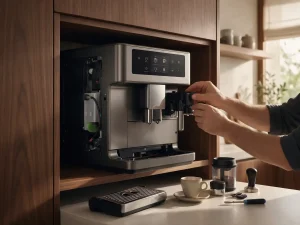
Placement matters as much as the weather. A machine tucked under an upper cabinet, beside a range or in front of a sunny window absorbs heat from its surroundings. Its vents may be blocked by a wall or a stack of mugs. Blocked vents leave heat trapped around the electronics, so moving the machine is a test as much as a precaution.
- Is there open space behind and above it?
- Does direct sun fall on it in the afternoon?
- Does it sit within an arm’s length of the oven or a toaster?
How to test the idea
Try making a cup first thing in the morning when the kitchen is cool, then again in the heat of the day. If the code only occurs in the second case, heat plays a role. Tell the technician. It does not prove the machine is healthy, since a part near its limit may fail in heat and still need replacing.
What gets checked first
The electronics and heater are measured at operating temperature, along with the airflow around the machine. Cooling paths, vents and any internal fan are considered where the model has them. Checking at operating temperature matters because a part can measure normally when cold and fail only once warmed through.
Outside actions
- Move the machine so its vents face open air, not a wall.
- Remove anything resting on top of it.
- Let it cool for half an hour before another attempt.
Never cover the machine with a cloth to protect it from the sun.
Why the evening cup looks fine
By the time the sun goes down and the oven is off, the kitchen cools and the machine regains its margin. That makes a heat-related fault feel like a ghost: present when nobody is trying to document it, gone when the technician arrives. Photograph the display at the moment it happens, and note the time and room temperature if you have a thermometer.
When it is service
If E20 returns in cool weather, or repeats at moderate temperatures after moving the machine, schedule a diagnosis. Heat-sensitive parts have to be measured inside the housing. A written estimate follows the diagnosis, and no part is replaced without your approval.
Frequently asked questions
Heat reduces the margin of the heater and electronics. If your code follows the weather, tell the technician.
Away from direct sun and from the range, with open space around its vents.
Not by itself, because the meaning depends on the model. Still, heat is worth ruling out.
It may make the code disappear for a while, but a part that fails in heat usually returns.
Model compatibility: Bertazzoni reuses codes across series and model years, so E20 may mean something different on another appliance or generation. Confirm this against your model’s documentation and record your full model number before acting.